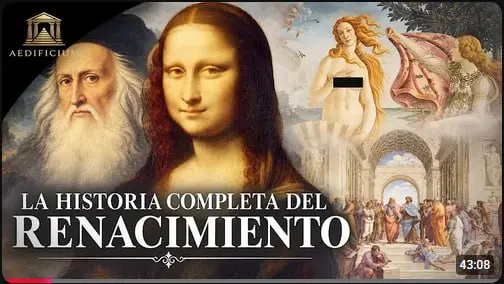
Last week, my husband and I were watching a film on YouTube. When we paused, a selection of recommended programmes appeared, among them one about the Renaissance. A familiar collection of images greeted us: Leonardo da Vinci, the Mona Lisa, and Venus from Botticelli’s Birth of Venus. Except that something was terribly wrong with the latter.
A black rectangle covered her breasts.
I stared at the screen in disbelief. Botticelli’s Birth of Venus, one of the most celebrated paintings of the Italian Renaissance, had apparently become too revealing for a thumbnail advertising a programme about precisely that period. I mean, seriously. Why?
Not knowing whether to laugh or cry, I was puzzled by the contradiction. The Renaissance, with its renewed fascination for classical antiquity, the human body, proportion, and beauty, was being presented through some of its most recognisable masterpieces. Yet one of them had been altered to accommodate what appeared to be a concern about nudity. Imagine visiting the Uffizi Gallery in Florence, only to discover that someone had placed a black rectangle over Venus’s breasts. One would surely question the rectangle, not the painting.
Of course, the way we look at art depends considerably on what we bring to it. I remember a painter friend once admitting that his early interest in art had been motivated, at least partly, by the opportunity to look at naked women without anybody objecting. A rather practical introduction to art appreciation, I thought. And a useful reminder that not everyone encounters a painting through the same lens.
An art historian may recognise Venus, Botticelli, and the Renaissance. Someone unfamiliar with any of them might simply see a beautiful naked woman. Both are looking at the same image, but their attention may settle on very different things. Neither response necessarily excludes the other.
This is where the black rectangle becomes particularly peculiar. It seems to anticipate one possible reaction and, in doing so, imposes that concern on everyone else. Without it, I would simply have seen Botticelli’s Venus. With it, my attention was immediately directed towards her breasts. What had been part of a familiar composition suddenly became something singled out as potentially objectionable.
And I find myself wondering when the possibility of one interpretation became sufficient reason to interfere with an image before anyone has even had the opportunity to look at it.
November 2026: The Black Rectangle
When Censorship Changes What We See
Botticelli’s Venus, c. 1485. Censored in the 21st century.