For a couple of months now, my husband has immersed himself in the world of 3D printing. A colourful library of filaments is steadily piling up in his workshop, each spool representing a new potential for precision in plastic. In my world, this means of production stands as the ultimate antithesis to my values. To me, there is nothing more lifeless than an object birthed from code and synthetic layers; it is the very definition of soul-less.
Yet, I find myself fascinated by the joy I observe in him. He creates with a sense of genuine purpose, printing everything from specialized spare parts for his power tools to elegant, highly functional plant pots with deep reservoirs that simply cannot be found in shops. It is his passion for these bespoke solutions that begins to breathe a strange kind of life into the material.
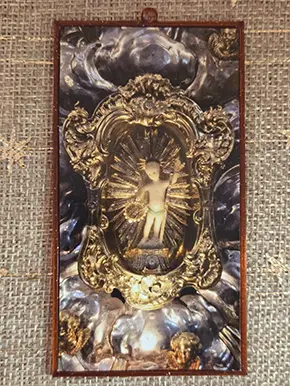
A recent journey to Christkindl in Steyr – a lovely historic town in Upper Austria where I spent five formative years at school – offered a bridge between our two disparate realities. At the heart of the altar at the pilgrimage church there sits the original "Christkindl", a small, delicate figure of the infant Jesus made of wax by a local nun in the 17th century. It is an object radiating with history and the quiet intensity of handmade devotion. I left the site carrying a small Andachtsbildchen (a traditional devotional image) of this child, a paper echo of that centuries-old soul.
I eventually asked my husband to print a frame for it. I wanted something very simple, a clean vessel that would not dilute or distract from the image itself, finished with a small loop so I could hang it on our Christmas tree.
As I held the result, I was struck by the contradiction. Here was an object from a world I often find appalling – synthetic and machine-made – yet it was undeniably vibrant. Because it had been created upon my request, with the specific intention of housing something I treasure, the meaning we both poured into it began to animate the plastic.
It leads me to a profound, almost unsettling question: If we can breathe life into a 3D-printed frame simply through our own perception and the joy of creation, does my vocation at Bespoke Vienna become obsolete? If the observer and the intention provide the soul, does the origin of the object truly matter?
I have come to believe that the answer lies in the difference between a mirror and a source. A 3D-printed object can be a perfect mirror, reflecting our personal stories and practical needs back at us. But the artisan's work – like that 17th-century wax child – is a source. It holds an intrinsic, radiating truth that exists independently of our gaze. The "alchemy of meaning" allows the modern to serve the sacred, but it only confirms that our world still hungers for objects worthy of the immense breath we give them.