The question of what to preserve after death has never produced a single answer, because it depends entirely on what a culture believes must survive it. A journey through the cultural history of the dead.
The Chinchorro people of coastal Chile, whose mummification practice predates the Egyptian by several thousand years, kept their dead physically present among the living: bodies were dried, reinforced with sticks and clay, repainted when they showed signs of deterioration, and returned to the community rather than buried away from it. The dead remained, visibly, among those who had known them. The preservation was social before it was spiritual.
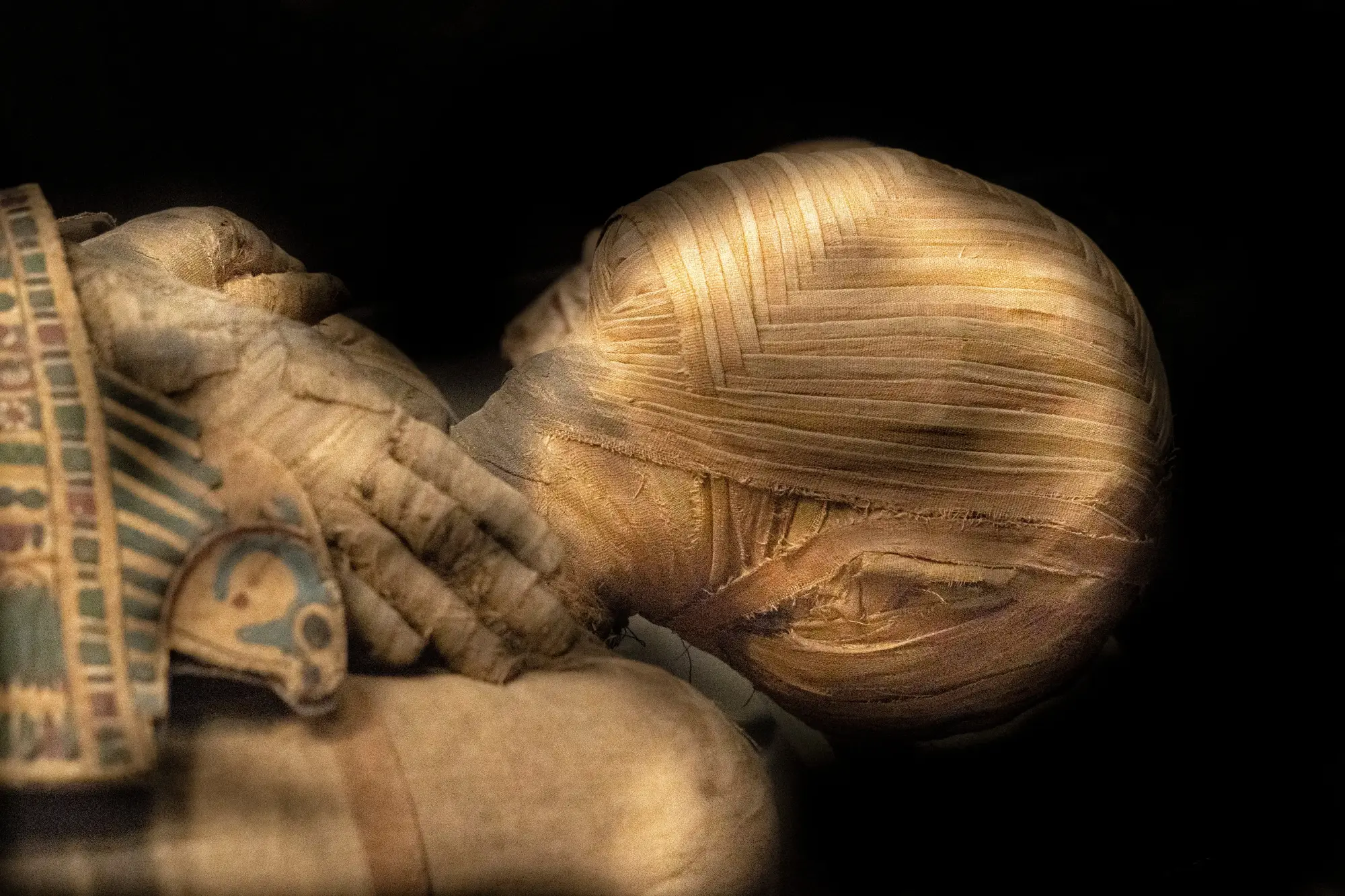
The Egyptian answer was theological. The soul required the body to return to, which meant the body had to be kept intact and recognisable across an indefinite span of time. Natron drew out the moisture that would otherwise feed decay. Linen wrapping held the form. Belief became procedure.
Celtic burial practice, and that of countless other cultures across Europe and beyond, worked differently again. What accompanied the dead was not the preserved body but the objects that had constituted a life: a comb, a weapon, a vessel, jewellery, tools. The logic implies that identity is portable, carried not in flesh but in things. What makes a person recognisable travels with its attributes rather than residing in the body itself.
The Qin emperor Qin Shi Huang took this to its furthest extreme. Rather than preserving his own body or burying his personal objects, he replicated his entire world in ceramic: more than eight thousand individually modelled soldiers, horses, chariots, and officials, an army that would serve him in death as it had in life. The afterlife, in this logic, required not just a person but a complete social order. One body was never going to be sufficient.