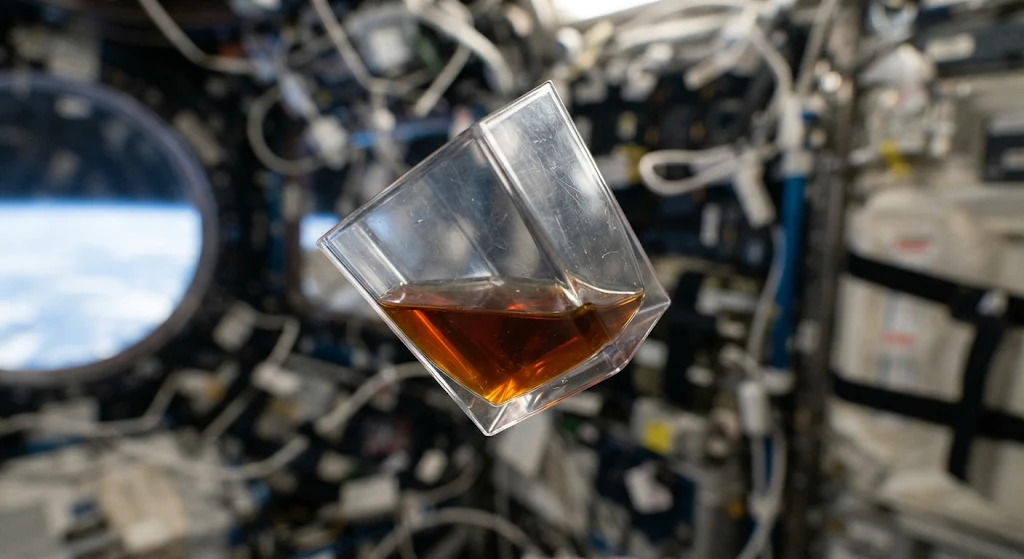
Tea was already on the menu of the first Space Shuttle mission in 1981, when it travelled as a powder, mixed with water like other powdered drinks on the Shuttle menu. The difficulty lay in the vessel, because hot liquid does not stay in an open cup in microgravity, and a tea bag brewed in a sealed pouch cannot be taken out. The British astronaut Tim Peake, who spent six months on the International Space Station, wrote that the problem that struck him before launch was the strength of the brew: too weak at first, and by the end the drinker would be sucking on a tea bag.
One answer was to engineer the vessel. Peake describes a cup whose shape was worked out by mathematical modelling, so that a capillary connection forms when the drinker sips and holds the liquid in place without gravity, and he reports that NASA certified his favourite brew fit for space travel.
Another answer was to remove the leaf. The Japan Aerospace Exploration Agency, JAXA, certified a powdered green tea made from condensed, spray-dried extract, which leaves no dregs behind and is prepared by injecting hot water into the pouch, and the manufacturer’s description, published by JAXA, presents it as a way for astronauts to take a break and relax during demanding missions. Where one solution reshaped the cup around the leaf, the other removed the leaf from the cup, and both arrive at the same result: a pause, taken in orbit as it would be anywhere else.