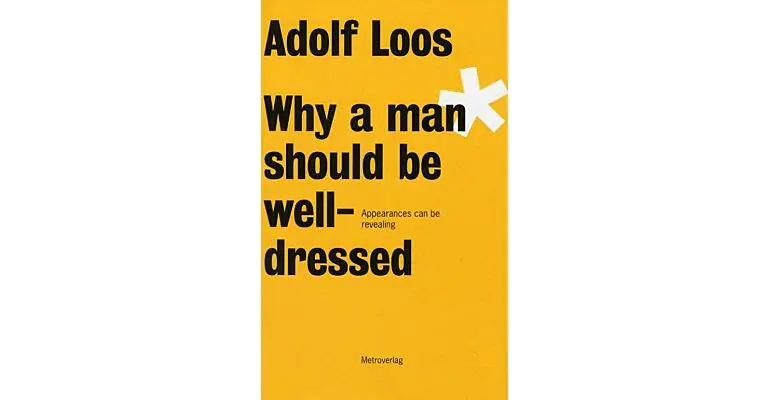
Adolf Loos is usually remembered for architecture and his attack on ornament, but he also wrote extensively about clothes. In his 1898 essay Die Herrenmode, good dress had surprisingly little to do with beauty. The standard was correctness. A red tailcoat in a ballroom was wrong because it attracted attention, just as a top hat on the ice was wrong for the same reason.
This was not an argument for indifference to clothes. Quite the opposite. Correct dress required knowledge of occasion, proportion, fabric and detail, all applied with enough restraint to remain almost invisible. The suit suited this logic perfectly: a modern garment from which overt decoration had largely disappeared, leaving cut, cloth, fit and judgement to carry the distinction. Simplicity had not removed complexity. It had concealed it.
Loos’s social hierarchy belongs unmistakably to his time, but the principle survived it. The modern suit became visually quieter without becoming intellectually simpler. Its language merely moved into details that required knowledge to read.