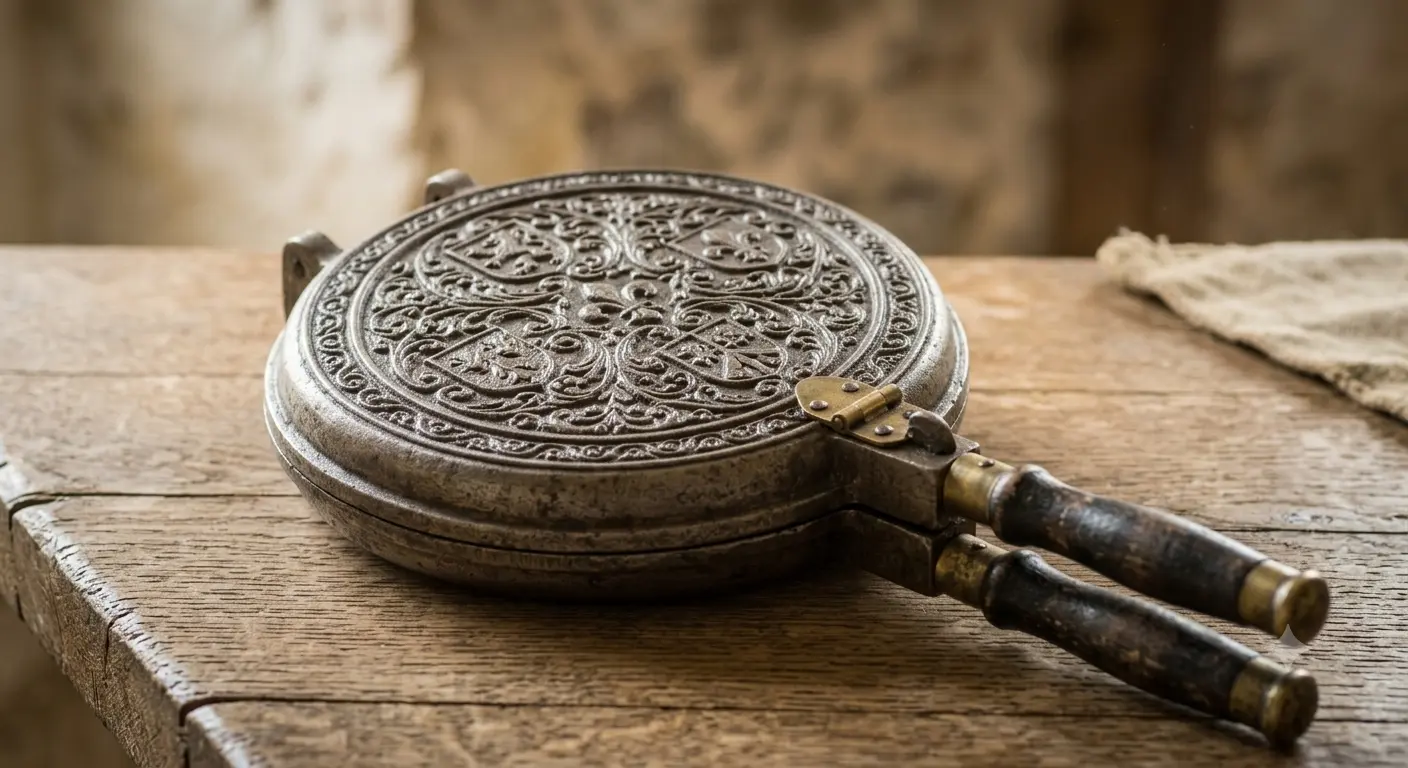
The wafer iron, two hinged metal plates with long handles held over an open fire, is a medieval instrument that has changed remarkably little in its basic principle across eight centuries of use. What changed was what its makers engraved into the plates: geometric patterns, heraldic devices, religious imagery, family crests, celebratory motifs. The iron was not merely a cooking tool but a statement of identity, and surviving examples in museum collections across Europe show that decorated wafer irons were given as wedding gifts, commissioned by monasteries, and personalised for households that wanted their mark pressed into every wafer they produced.
In medieval cities, wafer makers sold their goods at markets, known in French as oublieurs, from the word for the thin wafers they carried. The same iron that produced the Eucharistic host in a monastery sacristy was producing street food at the market square.
The industrial wafer machine of the nineteenth century is a scaled-up version of the same hinged plate principle, running on electricity rather than fire, pressing the same grid into the same batter at the same basic temperature. The recipe changed, the principle did not.