As it comes with the work, social interaction has begun to diversify again. Conversations unfold on many different layers. Family. Close friends. Those one feels connected to, but not deeply. People one meets briefly, perhaps at a vernissage, where there is an instant sense of affinity. Social obligations, where common ground is limited, yet presence is expected. Business encounters, which in themselves range from deeply aligned to something one simply wants to conclude as quickly as possible.
Some of these encounters feel natural, even uplifting, leaving one light, perhaps inspired. Others are a tour de force, leaving one drained, demanding hours of recovery. And yet, they all have one constant: me as the conversation partner.
It has always been important to me to remain fully authentic in these interactions. Not to pretend, not to perform, not to distort myself to the point where I become someone else entirely, simply to meet the other halfway. Of course, beneath all of this lies a layer of social interaction that remains constant: good manners, a shared code of behaviour, a certain predictability that allows people to move through situations without friction. Whether one sits with a close friend or meets someone in a professional setting, this outer framework does not change.
Within that framework, however, I have long assumed that authenticity meant one thing: to be fully present, one hundred percent, regardless of context. It felt honest, and in a way it was. But it left no room for distinction. Everything unfolded on the same level, with the same intensity.
What I have begun to understand is that the difference does not lie in how one behaves, but in how one places oneself. The external form remains the same. What shifts is the degree of presence within it.
Rather than adjusting myself in every interaction, I began to think in terms of space. Of proximity. Of placement. Not everyone stands in the same position, and they do not need to. Some remain at a distance where exchange is light and without depth. Others move more freely, sharing a certain field of understanding. And then there are those few with whom closeness is not negotiated at all, but simply exists.
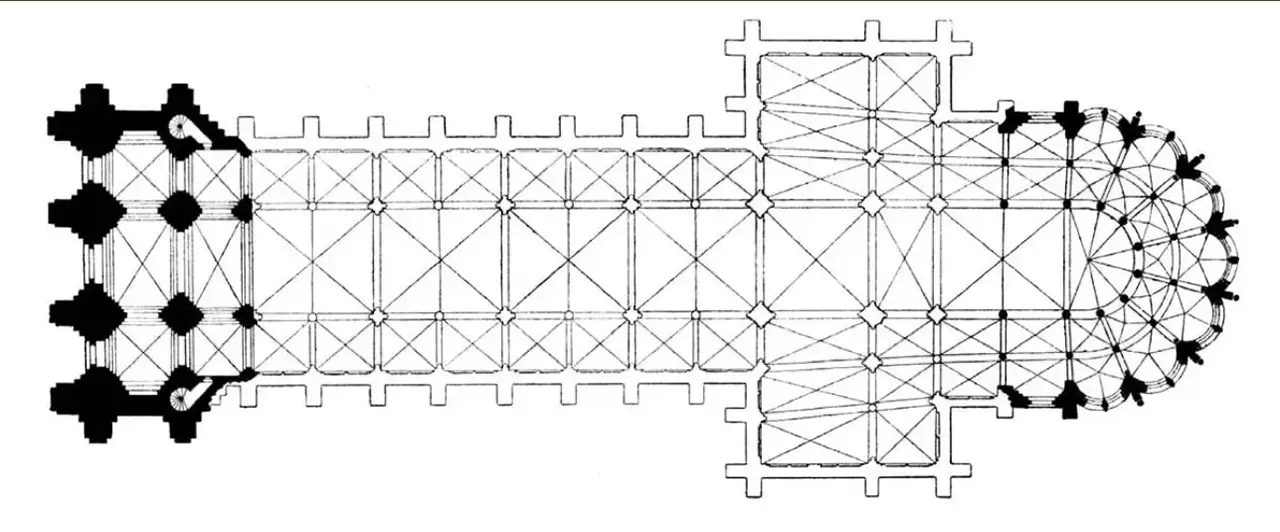
Perhaps this is why I found myself returning to something that has accompanied me since my early years in Art History. My fascination with Gothic architecture, with its clarity of space and its quiet, almost self-evident order. Studying floorplans of cathedrals with fresh eyes, I found myself struck not so much by their symbolism, but by their structure. The way movement is guided without force, the way not every space is the same, and yet everything belongs.
It is not a system I consciously designed. It is something I recognized. And with that recognition came a certain calm. Social interaction no longer feels like a constant calibration of intensity. It feels more like orientation within a space that already exists, where position replaces negotiation and closeness reveals itself without effort.